
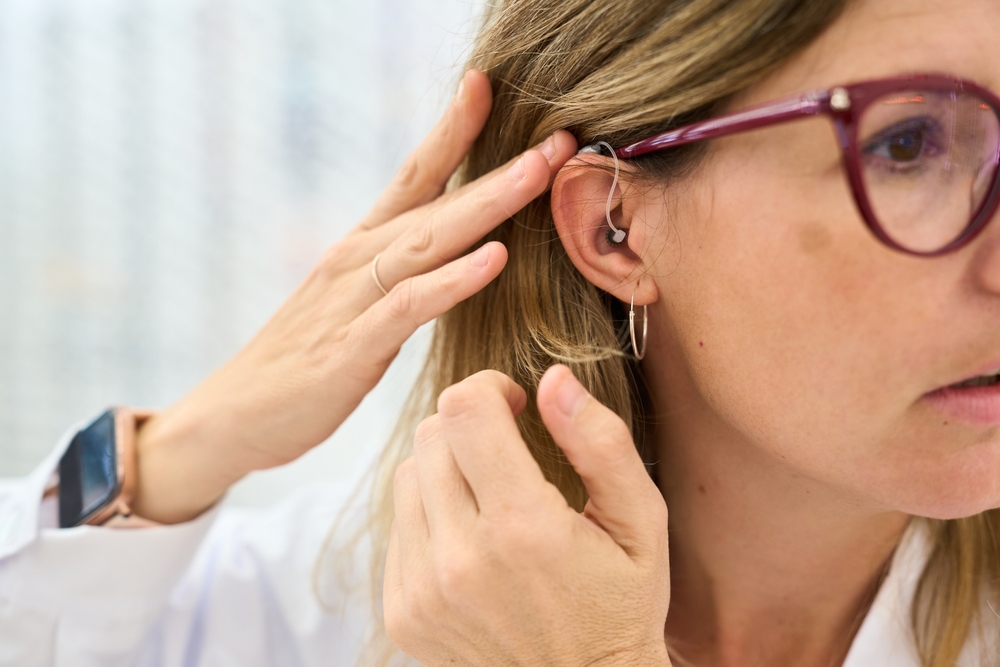
A significant number of patients postpone treating their hearing loss because they harbor concerns regarding device aesthetics and physical comfort. This hesitation is entirely valid given historical product designs! Furthermore, many individuals harbored deep anxieties about social isolation, fearing others would exclude them from discussions based on assumptions of cognitive decline or profound auditory deficits.
This obsolete perception remains deeply embedded in the public consciousness, creating a massive barrier to proactive treatment. But the reality is that today’s modern hearing aids look and feel very different from what you might expect. Ongoing innovations in cosmetic engineering mean today’s options are ultra-small, seamlessly comfortable, and beautifully hidden from public view.
If cosmetic anxiety has caused you to delay treating your hearing loss, it is highly recommended that you evaluate the sophisticated options now available.
The Hearing Aid You’re Picturing Doesn’t Really Exist Anymore
When asked to visualize a hearing instrument, the average person still envisions an awkward, highly conspicuous piece of hardware visible from yards away. If that’s the case, you’re thinking about hearing aids circa the 1980s and ’90s.
In the intervening decades, the entire field of otolaryngology and acoustic engineering has undergone a massive paradigm shift. Continuous refinements in ergonomic styling, nanometer-scale circuitry, and digital audio engineering have radically overhauled the modern cosmetic profile. The resulting devices are beautifully downsized, highly aerodynamic, and built to match lifestyle needs by remaining completely hidden.
A multitude of current designs fit entirely inside the physical ear canal, ensuring they remain hidden from view during normal social encounters. Alternative styles occupy a tiny footprint behind the pinna, utilizing ultra-light materials and customizable color palettes to match hair or skin tones perfectly.
Understanding Your Options: A Guide to Contemporary Device Form Factors
If you’re wondering what your main options in hearing aids actually look like, here’s a simple breakdown:
The Invisible-in-Canal (IIC) Form Factor
These are as discreet as it gets. An IIC device is positioned entirely past the second bend of the auditory canal, fabricated from a personalized physical matrix of your unique anatomy. From a normal conversational distance, they’re essentially invisible. They represent an ideal intervention path for mild-to-moderate hearing impairments when user stealth is the top priority.
The Versatile Receiver-in-Canal (RIC) / Receiver-in-the-Ear (RITE) Style
Statistically, this open-fit design represents the dominant choice among current consumers. The system utilizes an incredibly small housing resting behind the ear, linked by a hair-thin translucent cable to a miniature speaker within the ear pathway. At a glance, they often resemble wireless earbuds. Surrounding individuals will remain completely unaware of the technology unless they actively look for it.
Power and Performance: Behind-the-Ear (BTE)
This style positions the main component body post-auricularly, offering a slightly larger footprint that remains beautifully sculpted and sleek. Clinically indicated for profound or severe hearing deficits, they deliver immense acoustic power without the outdated, conspicuous mass of the past.
The key takeaway: Today’s discreet hearing aids are designed to fit your life, not announce themselves.
Advanced Features: Beyond Aesthetics to Smart Technology Integration
The changes in modern hearing aids aren’t just cosmetic. Today, they function more like smart devices than traditional medical equipment. A vast majority feature native Bluetooth connectivity, enabling seamless, wireless streaming of telephonic communication, media, and television audio directly into your auditory pathway.
Equipped with dedicated smartphone applications, they allow users to manipulate volume matrices or toggle environmental programs without making manual physical adjustments. Should you transition into a loud social environment, you can instantly recalibrate your directional microphones via your phone screen. Advanced rechargeable battery banks have effectively replaced the small, fragile power cells that used to cause immense frustration. You merely dock the devices on a nightstand inductive charger, exactly like replenishing your mobile phone.
Getting Over the Fear and Stigma of Hearing Devices
Despite being aware of these massive design improvements, it is entirely normal to feel a sense of hesitation. Initiating an auditory health journey can feel emotionally taxing because it requires acknowledging that our physical baseline has shifted over time. This mental hurdle can make an individual feel exposed, creating a false impression of losing authority over personal wellness.
However, an alternative, empowering framework exists: utilizing hearing technology is never an indicator of structural failure. They’re simply a sign of change, which happens to us all. Adopting this tech is definitive proof that you are actively taking charge of your health to empower and protect your daily cognitive function.
Visualize the freedom of utilizing a completely covert acoustic system that restores your ability to track jokes, engage in crowded restaurants, and capture every nuance of the activities you love. That is a magnificent example of reclaiming control over your life!
See For Yourself What Today’s Hearing Aids Look Like
The quickest way to erase your grandfather’s mental model is to physically interact with twenty-first-century hearing tech. We encourage you to drop by our office, address your concerns, and hold these miniature devices yourself with zero sales pressure. Consider it a chance to see and feel how different modern hearing aids really are.
The overwhelming majority of our patients leave their consultation thoroughly amazed by the compact scale, luxurious comfort, and acoustic clarity of current technology! Please contact our patient care coordinators or utilize our digital portal to secure your consultation this week.