
Discovering that an infant has hearing loss can be an upsetting and emotionally challenging experience for many parents, leaving them feeling lost and uncertain about what the future holds. But the bright side is: With early detection and intervention, babies with hearing loss can thrive. Indeed, they are capable of gaining linguistic skills, refining their communication techniques, and forming profound connections with their surroundings, inevitably giving rise to a rich and satisfying existence.
Two of the most effective tools for assisting babies with hearing loss are hearing aids and cochlear implants.
Understanding Hearing Loss in Infants
Hearing loss in infants can be triggered by a range of factors, including:
- Hereditary traits (even in the absence of a family background)
- Genetic infections including cytomegalovirus (CMV) or rubella
- Complications during birth, including lack of oxygen or prematurity
- Medications commonly administered in the NICU (Neonatal Intensive Care Unit)
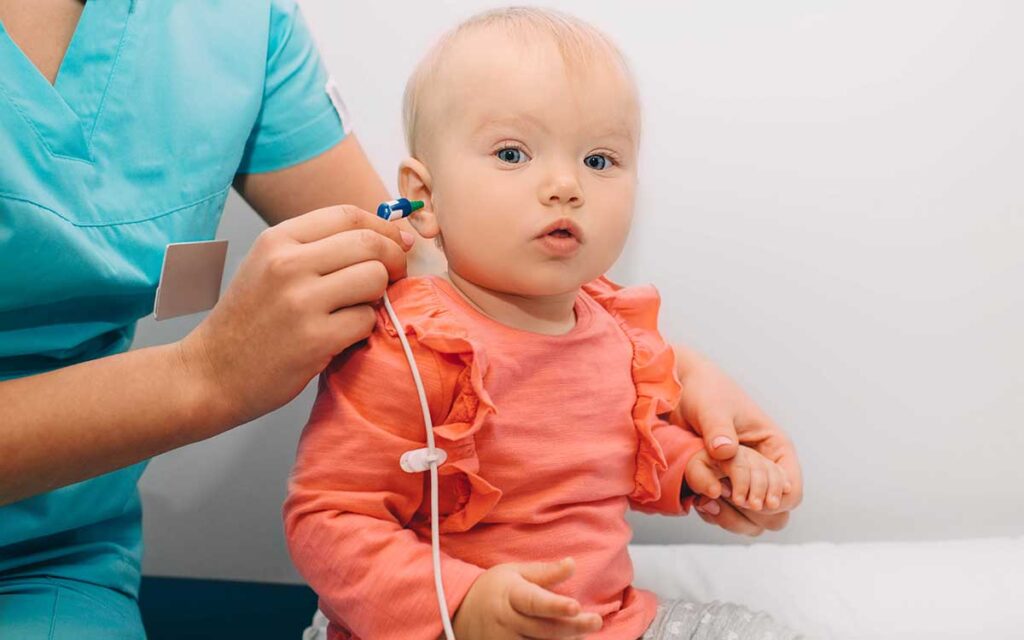
The most significant step? Early detection. That’s why infants in the United States are evaluated for hearing loss before they leave the hospital. Pediatric professionals adhere to “1-3-6” hearing protocol.
- Screened by 1 month
- Diagnosed by 3 months
- Intervention (with hearing devices or therapy) started by 6 months
Reaching these developmental milestones is essential for babies to achieve optimal progress in speech, language, and cognitive growth. For individualized guidance on these screenings, don’t hesitate to reach out to your pediatrician.
Hearing Aids for Babies and Toddlers
For babies with mild to severe hearing loss, hearing aids are often the first line of treatment. These tiny, portable devices amplify audio signals, enabling infants to better detect and comprehend voices and surrounding noises.
Hearing aids are:
- Safe for infants as young as a few weeks old
- Designed with gentle, cozy earpieces that adapt according to the baby’s development
- Featuring secure battery doors and child-friendly design features
- Custom-programmed by a pediatric audiologist to fit your child’s hearing profile
As your infant develops, hearing aids will need to be adjusted regularly to guarantee proper fit and effectiveness.
Cochlear Implants for Infants
A cochlear implant may be suggested for a baby with extreme to profound sensorineural hearing loss who does not obtain sufficient benefit from hearing aids.
Unlike hearing aids, cochlear implants:
- Are embedded with a surgical procedure
- Circumvent damaged parts of the inner ear
- Convert audio into electric impulses that directly activate the hearing nerve
Benefits of Cochlear Implants:
- FDA-approved for babies as young as 9-12 months
- Most successful when coupled with early treatment and family support
- Suggested only after a thorough evaluation by an audiologist and ENT specialist
This procedure involves the use of imaging, auditory examinations, and dialogues relating to future prospects and results
Hearing Aids vs. Cochlear Implants: What’s the Difference?
Hearing aids:
- Mild to severe hearing loss
- Non-Invasive
- Sound processing amplification
- Starts at Infancy
Cochlear Implants:
- Severe to profound hearing loss
- Invasive (Surgical)
- Converts Sound Electrical Signals
- Starts at 9-12 Months
Comparing Sound Enhancement Solutions: A Concluding Analysis
If your baby has been diagnosed with hearing loss, you have solutions and a lot of assistance. With the assistance of pediatric hearing experts, many children go on to develop language skills that are on par with their peers.
Taking swift action can have a profound and lasting effect on a child’s life, regardless of whether they require hearing aids or cochlear implants to deal with their hearing needs.
Have questions about your child’s hearing health? Call us now to set up a comprehensive evaluation and tailored treatment strategy.
Sources:
cdc.gov/ hearing-loss-children-guide/ parents-guide/understanding-hearing-loss. html.
boystownhospital.org/knowledge-center/hearing-aids-babies.
hopkinsmedicine.org/health/treatment-tests-and-therapies/cochlear-implants/childrens-.
cochlear-implants.
dukehealth.org/blog/hearing-aids-vs-cochlear-implants.